




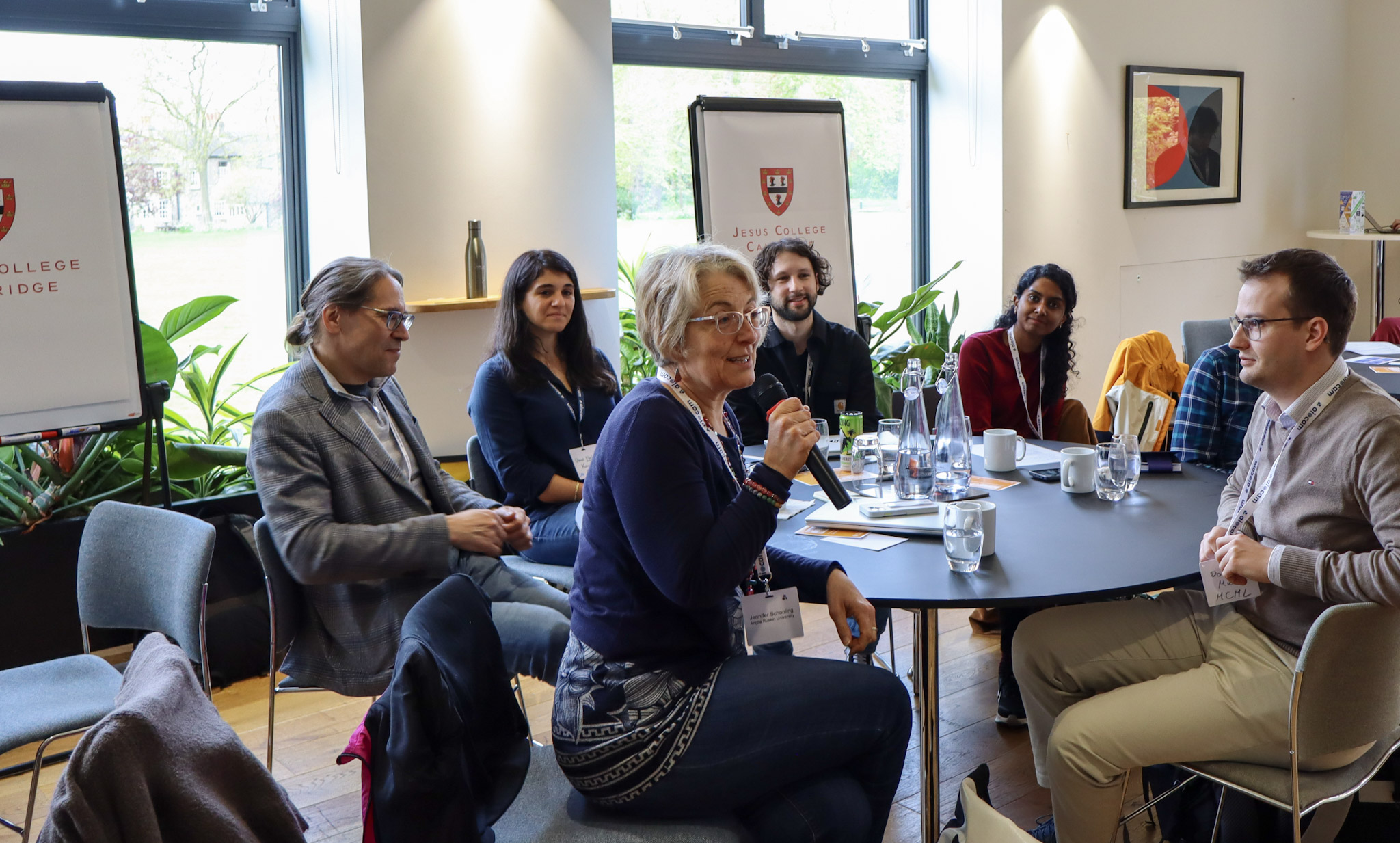
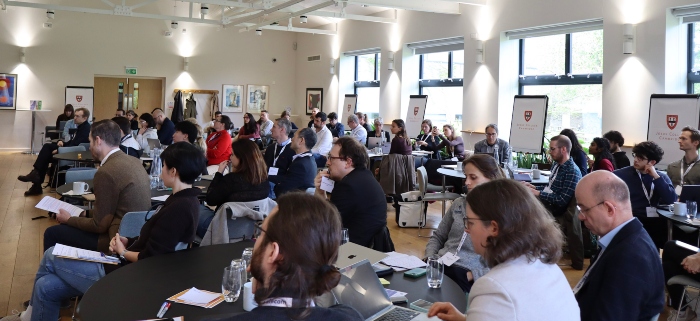
Over sixty researchers from the University of Cambridge and the Munich Center for Machine Learning (MCML) gathered in Cambridge on 16 April 2026 for a working session on what closer UK–Germany partnership on AI for science might look like in practice.
Hosted by ai@cam, the day was an exchange of research insights and a discussion about infrastructure — funding models, training pipelines, and the conditions needed to hold joint projects together over time.
Three threads emerged from the afternoon’s breakout discussions.
The first was an opportunity to bring PhD students together through summer schools, open-agenda hackathons, and expanded exchanges, letting working relationships form organically before they’re formalised.
The second was the need for funding to support experimentation, which could include: PhD-level support at a foundation, seed grants for early-stage research exploration, and proof-of-concept funding to de-risk ideas before they’re put forward for larger investment. The logic is that cross-border collaboration fails most often not at the ambitious end but at the beginning, when there’s no mechanism for two researchers to simply try something together.
The third was the recognition that the UK and Germany — and the different scientific domains within them — are developing different approaches to AI in science. Participants reflected on how shared research ambition sits alongside these different national and disciplinary contexts, and what that means for the design of joint work.
“What struck me most today is just how aligned our two communities are — not just in the technical approaches we’re taking but, also, in our shared recognition that AI for science is still a field being shaped,” said Professor Daniel Rückert, Alexander von Humboldt Professor for AI in Medicine and Healthcare at the Technical University of Munich. “AI has the potential to fundamentally change the pace and ambition of scientific discovery, but that only happens when you create the conditions for genuine collaboration. Science has always thrived on diversity of thought — the question now is how we turn today’s conversations into something lasting.”
The morning’s keynotes set the technical backdrop: Richard Turner (Cambridge) on data-driven weather forecasting, Barbara Plank (LMU Munich) on human-centred and inclusive language models, and Jennifer Schooling (Anglia Ruskin) on what responsible AI looks like in practice. A flash-talk session surfaced work ranging from physics-informed graph neural networks for blood flow modelling to an AI-agent framework for scientific discovery.
Megan Ennion, speaking on the closing panel, made the case for embedding international partnership into research training from the outset: “Collaboration shouldn’t be an afterthought in research careers — it should be part of how we learn to do science from the start.”
Jessica Montgomery, Director of ai@cam and the Accelerate Programme for Scientific Discovery, framed the day’s ambition in similar terms. “The UK and Germany are both home to world-leading AI research communities, and events like today remind us how much we stand to gain by working more closely together. Realising AI’s full potential for science demands active engagement across institutions, disciplines, and borders — and the conversations we’ve had today are the kind that turn into lasting partnerships.”