Local Government AI Accelerator
- Closed on: 13 February 2026





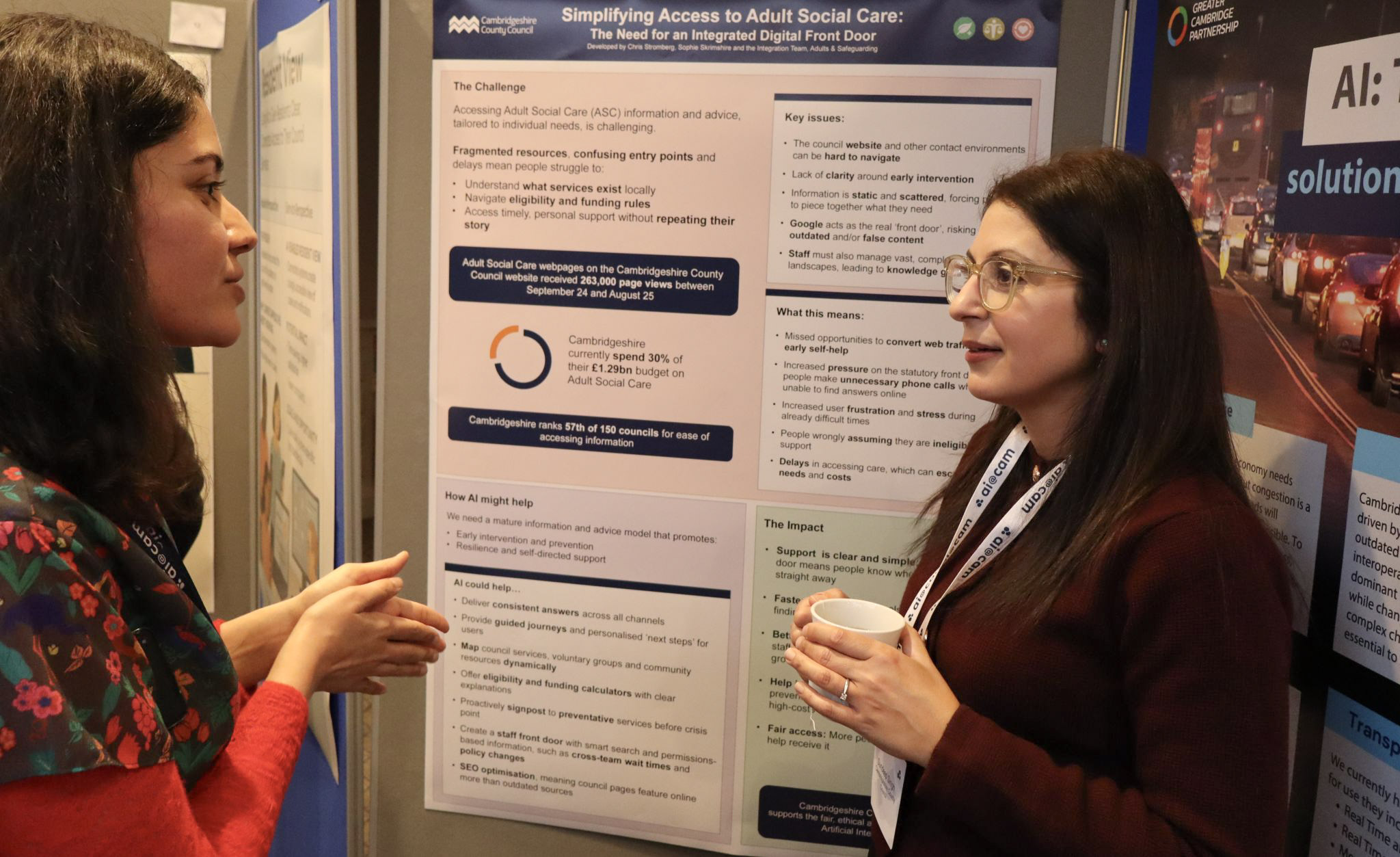
New funding scheme supports collaborative research projects between University of Cambridge and local authorities.
The University of Cambridge is launching a new funding scheme to support collaborative AI research and development projects with local government partners. The ai@cam Local Government AI Accelerator will provide grants of up to £25,000 for proof-of-concept projects that address shared challenges across multiple councils.
The fund represents a new approach to AI innovation in public services, connecting academic expertise with real-world operational needs. Projects must demonstrate clear buy-in from at least one local authority partner, be led by a University of Cambridge researcher eligible to hold funding, and deliver results within 12 months.
The initiative builds on ai@cam’s work with local government partners across Cambridgeshire and beyond. Early AI adopters in local government are already demonstrating the technology’s potential in areas like social care, planning consultation analysis, and infrastructure maintenance. This collaboration aims to support councils in identifying promising AI applications and developing appropriate solutions.
Deadline: 16.00 on Friday 13 February
Funded projects will receive up to £25,000 for 9-12 months of proof-of-concept development, with ongoing support through monthly community of practice sessions and technical support clinics with ai@cam’s machine learning engineers. A final showcase will document lessons learned and explore pathways for scaling successful solutions across the sector.
To apply, we ask for some basic project information, a two page project proposal, and supporting documents to demonstrate local authority support and headline spending plans.
Proposals must be submitted by 16.00 on Friday 13 February and should demonstrate clear partnership with at least one local authority.
Information session
We will also be hosting an upcoming Q&A information session about the funding scheme on 10:00 - 11:00, Thursday 15 January. You can register for this session here
We encourage all applicants to read the FAQs below before applying. If you have any further questions around eligibility or the application process, please contact Jess Montgomery (jkm40@cam.ac.uk.)
Apply here
The fund provides grants of up to £25,000 to support collaborative research projects between University of Cambridge researchers and local government partners. It aims to develop proof-of-concept AI solutions that address challenges in public service delivery in local authorities.
Applications must be led by a researcher based at the University of Cambridge and demonstrate clear buy-in from at least one local authority partner. We encourage applications that address challenges shared across multiple councils, as these have greater potential for sector-wide impact.
We have already heard from some local authority partners about areas where they would welcome support during a workshop on 24 November 2025. You can read more about these areas on our recent ai@cam blog.
Projects must have engagement with local authority partners throughout development, not just at the application stage. This means ongoing engagement with council staff who understand the operational context and can help ensure the solutions being developed address real needs.
We’re looking for proof-of-concept AI projects that address real-world challenges in local government. The call will not restrict topic areas (but you can read about areas that councils have already flagged as being of interest in our recent ai@cam blog.)
All projects must demonstrate clear public benefit potential. This might include:
Individual projects can receive up to £25,000 for 6-12 months of proof-of-concept development. Additional support including technical clinics, monthly community of practice sessions, and programme management is provided by ai@cam.
Funded projects must deliver within 12 months of receiving funding. This includes proof-of-concept development, testing with council partners, documentation of lessons learned, and presentation at the final showcase event. The timeline ensures solutions remain relevant to current council needs and maintains momentum for potential scaling.
Proposals will be reviewed to consider their:
Beyond financial support, funded projects will receive: monthly community of practice sessions to share progress and lessons learned with other funded teams; technical support clinics offering advice from ai@cam’s machine learning engineers; and focused workshops on shared challenges.
Alongside these project-specific activities, ai@cam will continue to convene networking sessions across councils to support sharing of lessons learned and successful solutions.
We strongly encourage projects to adopt open-source licensing (BSD) to enable sector-wide adoption and sustainable scaling. This ensures that successful solutions can be adapted and implemented by other local authorities without costly licensing barriers, maximising the public benefit of the investment. However, we also understand there may be times when commercial considerations require other approaches.
We strongly encourage applications that address challenges shared across multiple councils. Projects involving multiple authorities should set out how each partner will contribute and benefit.
While the programme builds on ai@cam’s existing relationships with Cambridgeshire councils, applications involving local authorities from other regions are welcome. The key eligibility requirements are active partnership with at least one council and a Cambridge-based researcher who is eligible to hold funding on behalf of the University. Strong applications that address challenges relevant across multiple authorities will be competitive regardless of geographic location.
Applications consist of a Google Form (covering basic team and partner details), a two-page project description, and supporting documents.
Your two-page description should cover:
You’ll also need to attach: a letter of support from your local authority partner to confirm their willingness to collaborate, and a budget breakdown showing how you’ll use the funding (up to £25,000). We don’t need detailed budgets at this time, but we are looking for headlines on breakdown of spend.
The Google Form requests the following basic project information:
For more information about the Local Government AI Accelerator, contact Jess Montgomery (jkm40@cam.ac.uk).
We will also host an information session about the funding scheme on 15 January, 10:00 - 11:00. You can register for this session here.