




As AI in local government moves from early experiments to wider adoption, many projects face a shared set of challenges.
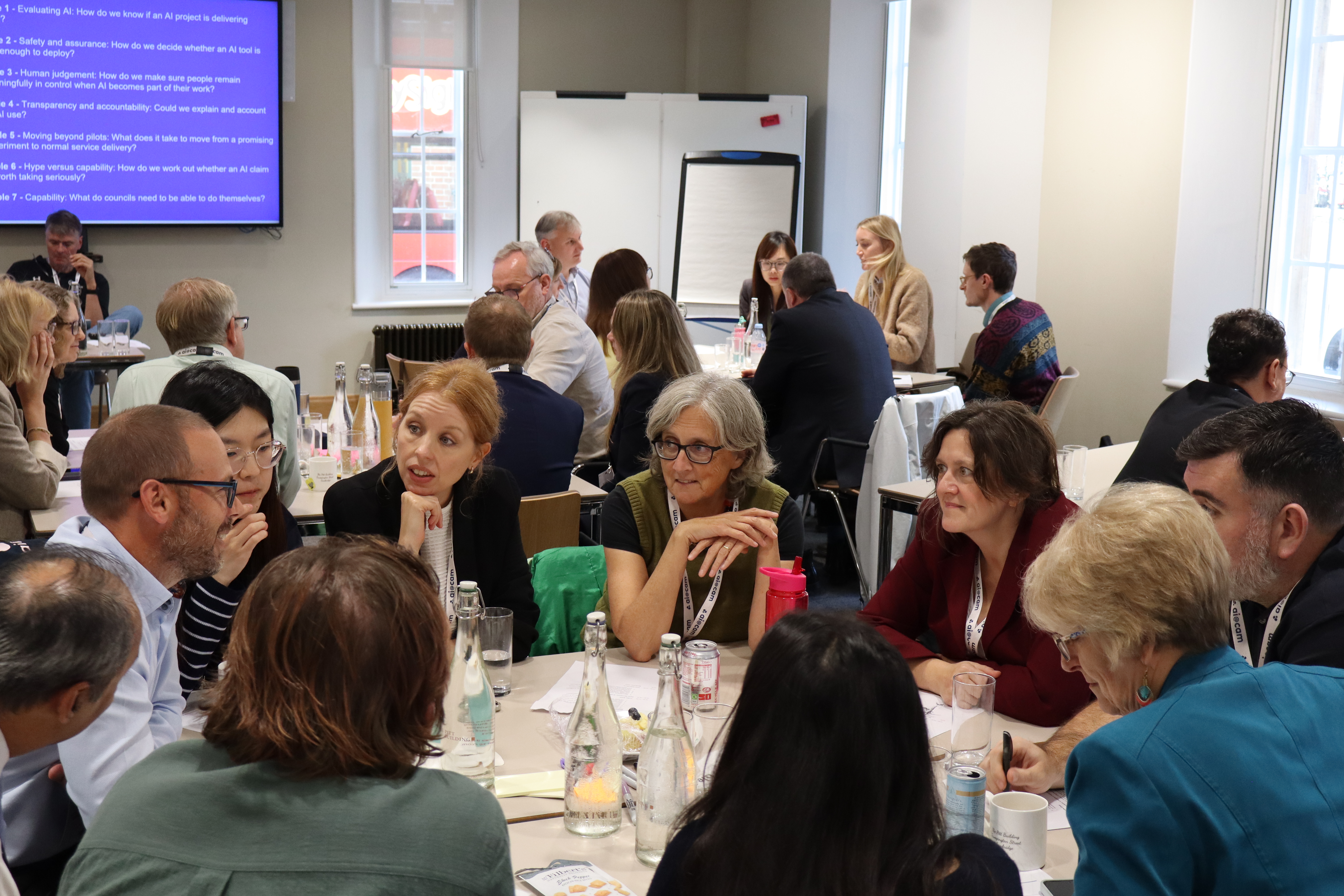
A recent ai@cam workshop heard from local government staff working on AI projects in customer contact, planning, housing, and council operations. While the application area varied, some questions kept emerging: How do you know whether a tool has improved a service? What information do you need from a supplier before you can use it with confidence? And where, as more work is automated, does human judgement need to remain? These are partly questions about technology. But looking underneath the technology buzz, these are questions about how councils understand, run, and change their services.
Starting with the service or workflow
Before asking what an AI tool can do, councils need to be clear about what they are trying to improve. One theme across the discussion was the importance of understanding the existing service before deciding where AI fits. Instead of looking for tasks that AI can perform, this means understanding how work currently happens: where time is spent, what information people use, where decisions are made, and where a process depends on experience or judgement.
This approach can reveal complexity that AI would otherwise elide. Work that appears repetitive may contain occasional points where something unusual happens and professional judgement becomes important. Processes can depend on tacit knowledge, conversations between colleagues, or workarounds that have never been formally documented.
Maintaining human judgement
Several of the projects discussed at the workshop were trying to remove repetitive work while preserving people’s time for more complex cases.
Many governance frameworks talk about having a human-in-the-loop. However, a person nominally checking an AI output tells us relatively little about whether meaningful judgement is still being exercised. Staff need to understand enough of the context to recognise when something looks wrong. They need to be able to question an output, and to have the authority to intervene if it seems wrong.
This is particularly important in local government. Many council services are not straightforward transactions. People may be contacting a council because they are facing problems with housing, money, social care, or other difficult circumstances. In those settings, reducing human contact is not typically a measure of success; at the same time, automating some work may be valuable because it creates more time for the interactions that need a person.
Moving evaluation beyond time saved
It is relatively easy to count tasks completed, enquiries handled, or staff time saved. It is harder to establish whether a service has improved. Participants returned repeatedly to the weakness of existing evaluation. Time and cost need to sit alongside other questions. Has the quality of the service changed? What has happened for the people using it? Has work been removed or displaced to another team? Has the new system introduced costs or dependencies that are not captured in the headline saving?
For public services, there is a further question about what should count as an outcome in the first place. Working backwards from the purpose of a service — including its statutory responsibilities — may provide a better basis for evaluation than starting with whatever the AI system makes easiest to measure.
AI assurance in practice
Another recurring challenge was the gap between the responsibility councils carry for using AI and the information they can obtain about the systems they can buy.
Councils can develop AI policies, undertake data protection assessments, and test systems in their own services. That does not necessarily tell them how a proprietary system was developed or where it is likely to fail. Supplier claims can be difficult to interrogate, particularly where there is little evidence from comparable settings. This becomes a procurement issue: What evidence should a council expect a supplier to provide? What testing should have been carried out? What does the council need to know about failure modes, updates to the system, or the use of its data? Common requirements for suppliers, shared approaches to testing and procurement, and better exchange of evidence from deployments could reduce duplication and give councils more leverage in such discussions.
Scaling from successful pilots
The skills needed to scale a pilot are broader than specialist AI expertise. Councils need to be able to map processes, define problems, specify what they need, challenge suppliers, procure effectively, evaluate outcomes, and manage organisational change.
As AI use becomes more widespread, many of these questions will recur across councils. There is an opportunity to move from isolated experimentation towards shared approaches to evidence, assurance, procurement and learning through peer networks of expertise and practice.
We’ll be continuing to work with our AI for Local Government Accelerator projects over the next six months to help build that community of practice. Find out more on our Policy Lab pages.