




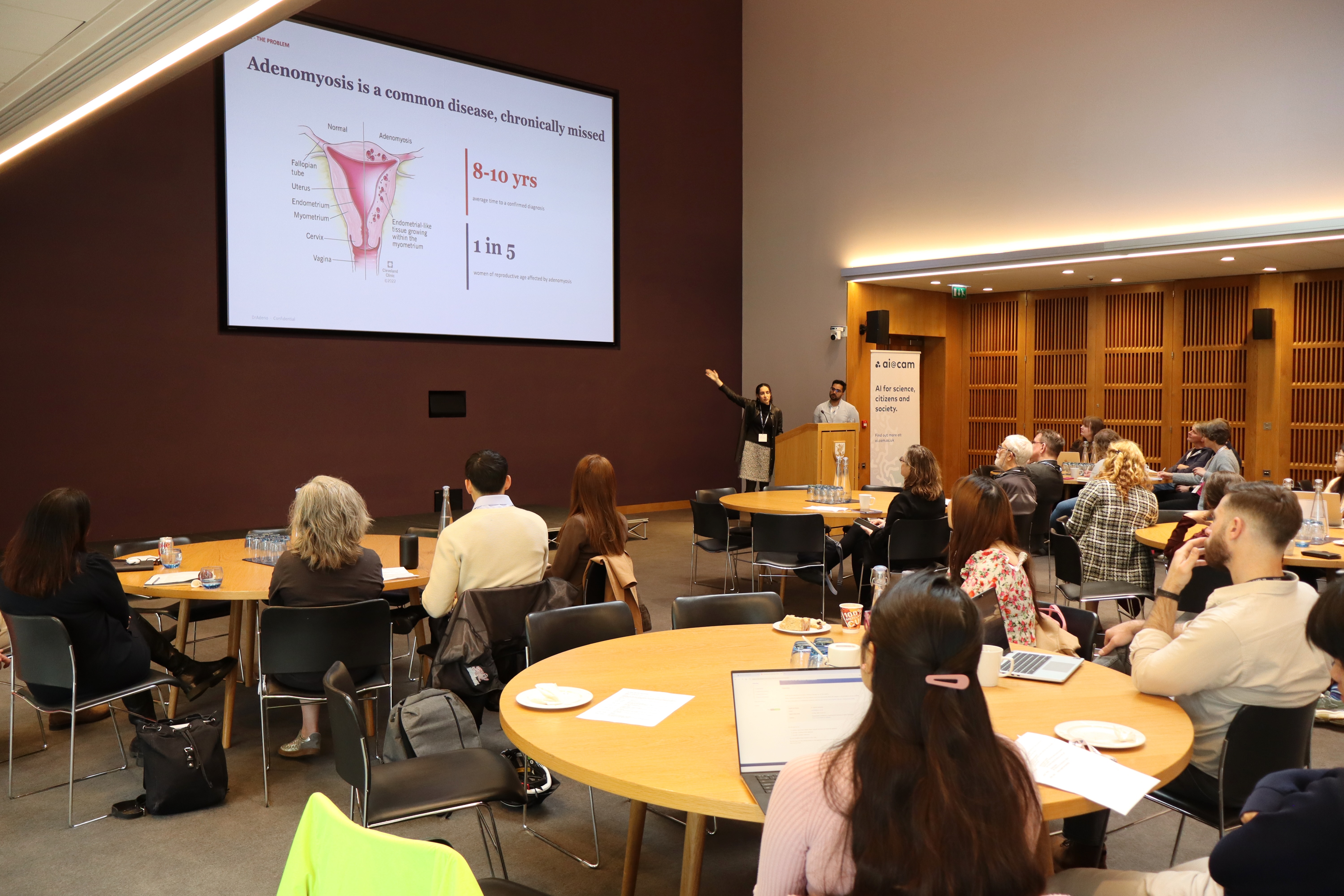
ai@cam was set up with the idea that AI’s value to science and society relies on empowering people who understand the problems they are trying to solve; helping them to work with the technology rather than being subject to it. The AI-deas Sprints Showcase on 14 May was an opportunity to see what this premise looks like in action. Our first cohort of Sprint projects covered topics ranging from the diagnosis of adenomyosis, to precision brain tumour surgery, rehabilitation of pelvic floor health, second language learning, land use planning, crop disease forecasting, the curation of conservation evidence, and agentic AI in science.
What these projects share is a way of working: innovation from the ground up, in which AI is put to work on a problem identified by the people closest to it. These are not projects in which a general-purpose model has been brought into a domain to look for things to do. They begin with a problem and ask where AI can help. The result is innovation that looks different from much of what currently dominates the public conversation about AI.
Innovation that starts from the problem
May Levin and Mo Vali’s team set out to address a bottleneck in the diagnosis of adenomyosis, in which patients can cycle for years between GPs, ultrasound clinics, and specialist centres without a diagnosis. The technical work — a platform that helps sonographers localise features of the disease during a scan and generates a structured report — is shaped by where the existing pathway breaks down. The same is true of Gita Khalili Moghaddam’s project on brain tumour surgery, which begins from the observation that pre-operative scans become unreliable once the skull is opened and the brain shifts, and that fluorescence-guided alternatives have known limitations. The thermal imaging approach is designed against those constraints, not a theoretical benchmark.
Mirjana Bozic and Linda Bakkouche’s language learning project began with a mapping exercise: what predicts second language attainment in adolescence, and where might a digital tool help? After understanding this, they designed an adaptive app. Sam Reynolds and colleagues working on Conservation Co-pilot started from a gap they had been documenting for years through the Conservation Evidence project, in which the loop between evidence and practice in conservation is, by comparison with medicine or aerospace, missing or weak. Jacob Smith’s work on crop disease advisories grew out of more than a decade of operational experience in early warning for wheat rusts, with AI introduced where it could lift a specific constraint — the rate-limiting step of expert summary writing — rather than as a starting point.
This pattern matters because the questions that get asked shape what gets built. A project that starts from a model capability tends to produce demonstrations. A project that starts from a problem in the world tends to produce something that has to keep working in the messy reality of real-world systems.
Most of the work is not the model
A recurring observation across the day was that the technical AI work was rarely the binding constraint. Gita put this most directly: AI capability is not the bottleneck on her project; data, workflow integration, and surgeon availability are. Variations of that observation came up in almost every presentation.
Significant effort goes into curating and managing data to enable these applications. Mo’s team has curated a clinical archive of ultrasound scans with the annotations that make them useful for training. Sam’s team has had to negotiate with publishers to allow the bulk ingestion of papers, open and closed, into a living evidence database. Jacob’s team draws from a standardised data infrastructure for plant disease forecasting. None of this is the kind of work that features in a paper title.
Workflow integration is similarly demanding. A platform that helps a sonographer mid-scan has to feed into the system the clinic already uses; a thermal imaging device for neurosurgery has to fit into a theatre workflow designed for other tools; a crop advisory generated by a language model has to pass through the expert sign-off that gives it standing with extension officers and farmers. Hristo Dimitrov’s pelvic floor project has had to think about the machine washability of a their sensor garments. Jerry Chen, Li Wan and Emily Wang’s PLATO platform has had to translate fragmented local planning data into something a non-specialist resident can navigate. These bring different types of system engineering needs.
Several teams also spoke about the human capacity needed to make these projects work, and the limits of that capacity. Surgeons willing to participate in trials have multiple demands on their time. Patients from affected populations need to be recruited carefully and supported through participation. Expert reviewers are needed to sign off on automated advisories, and their time is the resource being protected by the automation in the first place. While AI is the visible part of the work, the data, workflows, human relationships, and institutional arrangements around AI innovation are what shapes the technology’s success.
Where evidence comes from
If the hard parts of this work are data, workflows, and the careful integration of AI into existing practice, then the question of who is well placed to do that work becomes a substantive one.
Conservation Co-pilot is designed around the requirement that answers be transparent, citable, and legally defensible — capable of withstanding the scrutiny of a judicial review on the use of evidence in policymaking. The architecture reflects this: a clarification agent refines the question being asked, a supervisor routes queries to the appropriate evidence source, a hybrid search across a curated database of conservation literature, a meta-analysis run in a controlled environment, and a synthesis agent producing answers tied to citations under a fixed schema. The point of this construction is to produce evidence that a policymaker can stand behind.
Similar concerns run through other projects. Jacob’s team has developed automated summaries of disease surveys and forecasts, but decision-making responsibility still rests with expert reviewers; the team is working out how to preserve that authority while expanding the system’s reach from a handful of countries and diseases to many more. Boris Bolliet’s work on autonomous scientific discovery has been accompanied by the development of a reproducibility pipeline that reviews papers before results are shared with humans. In each case, the AI is being built in conjunction with the machinery that lets its outputs be trusted.
This is the work that determines whether AI ends up improving how decisions get made, or only how quickly they get made. Institutions that have spent centuries developing the practices of evidence — peer review, reproducibility, citation, careful disagreement — have something important to contribute in how such systems are designed.
Looking ahead
These projects are at different stages. Some are approaching clinical trials. Some are negotiating their next round of data access. Some are figuring out which parts of a workflow AI can usefully change. What they share is a way of working. Each project is led by people who understand the problem they are trying to solve, and who are using AI as one tool among others to make progress on it. Each is doing things that would not have been possible three years ago, benefitting from rapid progress in AI’s technical capabilities. Each is being built in a way that takes the question of what is trustworthy seriously.
What the showcase made visible is how much AI can do when it is put to work on problems that matter, by people who understand them.